
Home Buying Costs Explained: Down Payments, Closing Fees, and Budgeting Tips

The purchase price is only one part of buying a home. A $350,000 listing does not mean a buyer needs only a mortgage for $350,000 and a few signatures. Cash needed upfront, monthly costs, local taxes, insurance, and market pressure all shape the real number.
This guide breaks down the main costs so the process feels less like guesswork and more like a plan. This is informational only and not financial advice, so check with a qualified mortgage or tax professional for guidance tied to your situation.

Down payments are not one size fits all
The down payment is the portion of the purchase price paid upfront, separate from the mortgage. Many buyers hear that they need 20% down, but that is not always true.
Common down payment ranges include:
Loan type or situation | Typical down payment range |
Conventional loan | 3% to 20% |
FHA loan | 3.5% or more |
VA loan | 0% for eligible borrowers |
USDA loan | 0% for eligible rural and suburban properties |
Jumbo loan | Often 10% to 20% or more |
A larger down payment can lower the monthly mortgage payment and may help avoid private mortgage insurance, known as PMI. PMI often applies to conventional loans when the buyer puts down less than 20%.
That said, putting every available dollar into the down payment can leave a household short on cash after moving in. A lower down payment may make sense if it preserves an emergency fund and covers repairs, furniture, and the first few months of ownership.
For example, on a $400,000 home:
3% down is $12,000
5% down is $20,000
10% down is $40,000
20% down is $80,000
The right amount depends on loan options, monthly comfort level, cash reserves, and how competitive the local market is.
Closing costs can surprise even prepared buyers
Closing costs are the fees paid to complete the purchase and mortgage. They commonly run about 2% to 5% of the home price, though the exact amount varies by state, lender, loan type, and property.
Typical closing costs may include:
Loan origination or lender fees
Appraisal fee
Credit report fee
Title search and title insurance
Escrow or settlement fees
Recording fees
Prepaid property taxes
Prepaid homeowners insurance
Initial escrow deposits
Mortgage points, if chosen
On a $400,000 home, a 3% closing cost estimate equals $12,000. That is in addition to the down payment.
Some buyers negotiate for the seller to pay part of the closing costs. This is called a seller concession. It is more common in slower markets than in markets where homes receive multiple offers.

Monthly ownership costs go beyond the mortgage
The monthly mortgage payment is usually the biggest recurring cost, but it is not the only one. A full housing budget should include principal, interest, taxes, insurance, and other ownership expenses.
The main ongoing costs include:
Property taxes
Property taxes vary widely by location. Two homes with the same purchase price can have very different tax bills depending on the county, city, school district, and local assessment rules.
Homeowners insurance
Insurance costs depend on the home’s age, condition, location, coverage level, and risk factors. Homes in areas exposed to hurricanes, wildfires, flooding, or severe storms may cost more to insure. Flood insurance is separate from standard homeowners insurance and may be required in certain zones.
PMI or mortgage insurance
If the loan requires mortgage insurance, add it to the monthly estimate. FHA loans include mortgage insurance rules that differ from conventional loans.
HOA fees
Condos, townhomes, and some single-family neighborhoods charge homeowners association fees. These can range from modest monthly dues to large fees that cover amenities, exterior maintenance, or building reserves.
Maintenance and repairs
A common budgeting rule is to set aside about 1% of the home’s value per year for maintenance. The actual amount depends on age and condition. A newer home may need less at first, while an older home may need roof, plumbing, or HVAC work sooner.
Utilities and services
Electricity, gas, water, sewer, trash, internet, lawn care, pest control, and snow removal can all raise the true monthly cost.
Location and market conditions change the amount needed
The same financial plan will not work the same way in every market. Location affects both upfront cash and long-term affordability.
In a high-cost city, even a small down payment percentage can equal a large dollar amount. A 5% down payment on a $700,000 home is $35,000 before closing costs. In a lower-cost area, that same percentage may be much easier to save.
Local taxes also matter. Some states and counties have high property tax rates. Others may have lower annual property taxes but higher insurance premiums or HOA costs.
Market conditions shape negotiations too. In a buyer’s market, where homes sit longer, sellers may agree to repairs, price reductions, or closing cost help. In a seller’s market, buyers may need more cash to compete, cover appraisal gaps, or make a stronger offer.
Interest rates also change affordability. When rates rise, monthly payments increase, which can reduce buying power even if home prices stay flat.

A practical budget should start before house hunting
A strong homebuying budget works backward from comfort, not just approval. A lender may approve a higher amount than feels manageable month to month.
Start with these steps:
Estimate the full monthly payment
Include principal, interest, taxes, insurance, PMI, HOA fees, and utilities.
Set a cash target
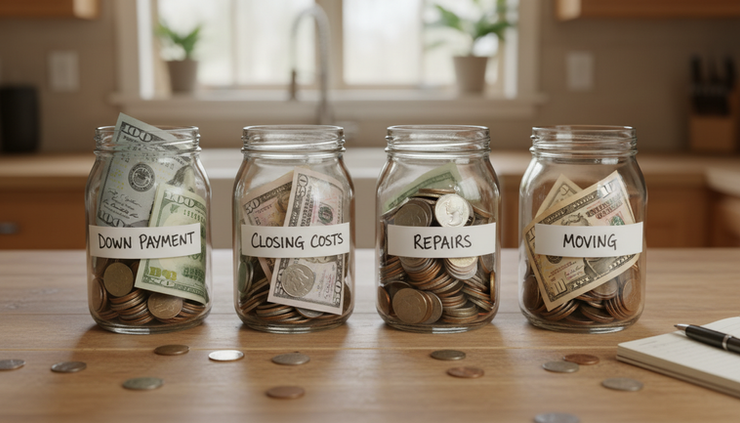
Add the down payment, estimated closing costs, moving costs, immediate repairs, and a post-closing emergency fund.
Protect emergency savings
Keep separate savings for job changes, medical bills, car repairs, or home emergencies.
Reduce high-interest debt
Paying down credit cards can improve monthly cash flow and may help with mortgage qualification.
Automate home savings
Set up a separate savings account for the home fund. Automatic transfers make progress easier to track.
Get preapproved early
A preapproval gives a clearer view of loan options, estimated payment, and cash needed to close.
A sample cash plan for a $350,000 home might look like this:
Cost category | Example estimate |
5% down payment | $17,500 |
3% closing costs | $10,500 |
Moving and setup costs | $3,000 |
Initial repair cushion | $5,000 |
Total savings target | $36,000 |
This is only an example, but it shows why the total needed can be much higher than the down payment alone.
The key takeaway for homebuyers
Home buying costs include far more than the sale price. The down payment, closing fees, taxes, insurance, mortgage insurance, HOA dues, maintenance, and local market conditions all affect the true amount needed.
A good plan leaves room for both the purchase and life after moving day. Before making an offer, calculate the upfront cash, estimate the full monthly cost, and keep enough savings to handle surprises. A home should feel like a place to live, not a budget stretched to its limit.



Comments